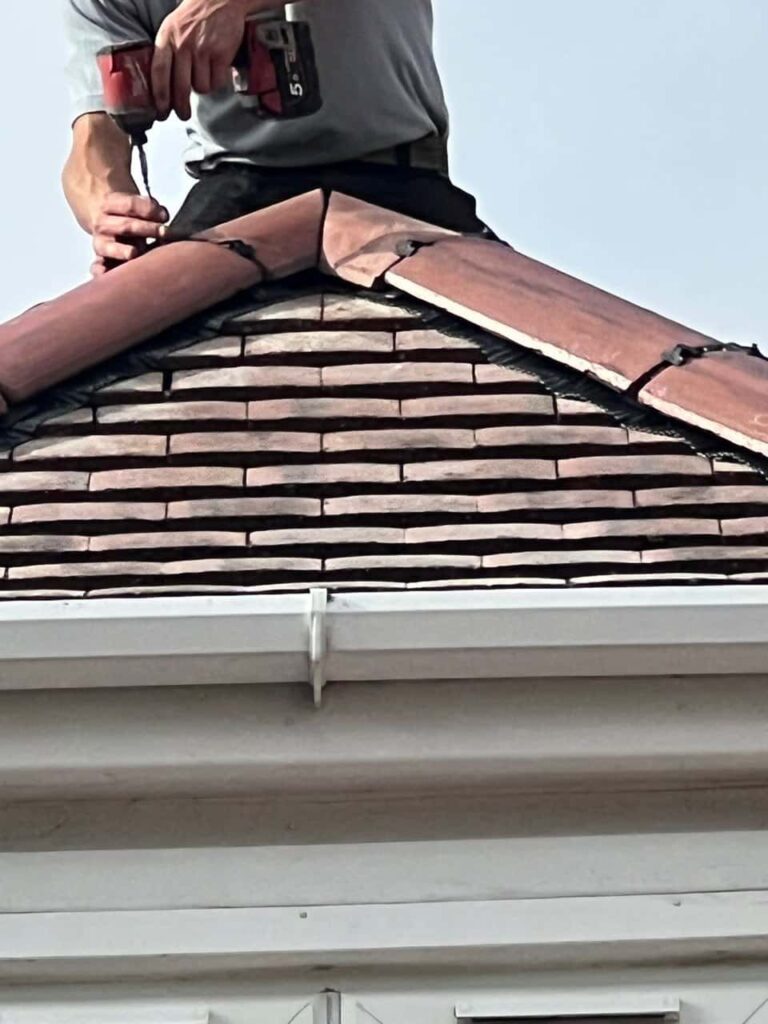
A roof tile that has moved out of position may initially look like a small and isolated defect. However, when tiles repeatedly slip, or several areas of a roof begin showing similar movement, there is often more to investigate than the visible tile itself.
Roof tiles rely on a combination of correct positioning, suitable fixings, sound battens and the surrounding roof covering to remain secure. If one of these elements deteriorates or becomes damaged, a tile can lose the support or restraint that previously held it in place. Simply moving the tile back may improve the appearance temporarily without resolving the reason it slipped.
For homeowners in Trowbridge, Wiltshire, recurring tile movement is therefore worth assessing properly. Understanding whether the problem comes from an individual damaged tile, failed fixing, deteriorated supporting material or a wider pattern across the roof allows repairs to address the cause rather than repeatedly treating the symptom.
What Causes Roof Tiles to Slip Out of Position?
There is no single reason why every roof tile slips. The cause depends on the condition of the tile and the components supporting it.
Common factors can include:
- Failed or deteriorated tile fixings
- Damaged fixing points on individual tiles
- Cracked or deteriorated tiles
- Problems with supporting battens
- Incorrectly positioned replacement tiles
- Movement within surrounding tiles
- Age-related deterioration
- Previous repairs that addressed only the visible problem
- Wind exposing an existing weakness
- Deterioration affecting a larger section of the roof
Establishing which of these factors is responsible is important because the correct repair for a damaged tile may be very different from the work required where supporting battens have deteriorated.
Roof Tiles Need More Than Gravity to Stay Secure
Tiles are laid in an overlapping arrangement across a roof slope, but their stability does not depend solely on their weight.
The tile design, supporting battens, fixings and surrounding covering work together to keep the roof properly arranged.
When one part of this system stops performing correctly, an individual tile may begin moving.
This is why repeatedly pushing a tile back into position is not necessarily a complete repair. The reason it was able to move in the first place still needs to be established.
Failed Fixings Can Allow Tiles to Move
Tile fixings play an important role in maintaining the stability of the roof covering.
Over time, individual fixings can deteriorate or become ineffective. When this happens, a tile may no longer be held as securely as intended.
The first obvious sign can be a tile that has moved lower down the roof slope or shifted away from surrounding materials.
If the tile itself remains serviceable, addressing the fixing may resolve a localised problem. Where similar failures occur across several areas, the condition of the wider roof covering deserves closer consideration.
The Tile Itself Can Become Damaged
Sometimes the fixing remains suitable but the part of the tile associated with its support or fixing has deteriorated.
From ground level, the tile may appear largely intact.
Closer inspection can reveal damage that prevents it from sitting or securing correctly.
Returning this tile to its original position without addressing the damage may result in further movement later. Where the tile can no longer be properly secured, replacing the affected unit may provide a more appropriate solution.
Cracked Tiles Can Become Less Stable
A cracked tile does not always fall or move immediately.
Depending on where the damage has occurred, it may remain in place for some time before movement becomes obvious.
Repeated exposure and normal roof movement can eventually allow the damaged section to shift.
Cracking should therefore be considered when investigating slipping tiles, particularly if the same unit has already required attention.
Battens Are an Important Part of the Supporting Structure
The visible tiles form only the outer part of a tiled roof.
Beneath them are battens that help support the covering and provide locations associated with tile fixing.
If a batten deteriorates or becomes damaged, the tile above may lose dependable support.
This can create a recurring problem because repositioning the tile does nothing to restore the weakened component underneath.
Where several neighbouring tiles are moving, the condition of the supporting battens becomes particularly relevant.
Hidden Deterioration Can Explain Recurring Problems
One reason repeated tile slipping can be frustrating is that the underlying defect may not be visible from outside.
A roof can appear generally complete while problems are developing beneath particular sections of the covering.
Tiles conceal battens, underlay and parts of the fixing arrangement.
When a tile repeatedly moves despite being repositioned, examining the components beneath and around it can provide a much clearer explanation than concentrating on the visible tile alone.
Ageing Roofs Can Develop Several Similar Defects
Roofing materials do not necessarily deteriorate at exactly the same rate, but components installed at a similar time have experienced broadly the same period of service.
As a roof ages, individual weaknesses can therefore begin appearing across different areas.
One slipping tile may remain a local problem.
If tiles start moving in several locations over a relatively short period, it can indicate that deterioration is becoming more widespread.
This does not automatically mean the roof needs replacing, but it does make a broader assessment increasingly worthwhile.
Wind Can Reveal a Weak Tile
Wind is frequently associated with slipped roof tiles.
However, the weather is not always the complete explanation.
A tile with a sound fixing and suitable support may remain secure, while one that already has a deteriorated fixing or damaged support can be more vulnerable to movement.
In this situation, windy conditions expose an existing weakness rather than necessarily creating the entire problem from nothing.
Investigating why a particular tile moved helps determine whether simply returning it to position is sufficient.
Exposed Roof Sections Can Show Problems Earlier
Different sections of the same roof can experience different levels of exposure.
Some slopes, edges and sections may be subjected to more direct weather than others.
If a weakness already exists within the tile covering, greater exposure can make movement apparent sooner.
The location of slipped tiles can therefore provide useful information during assessment.
A pattern concentrated within one particular section may suggest a different problem from random movement occurring throughout the roof.
Surrounding Tiles Can Influence an Individual Tile
A tiled roof works as an interconnected covering.
Individual tiles overlap and relate closely to neighbouring units.
If surrounding tiles have shifted, become damaged or been installed incorrectly, one tile may no longer sit as intended.
Repairing the affected area should therefore include consideration of neighbouring materials rather than treating each displaced tile as completely independent.
Restoring the correct local arrangement can be just as important as securing the tile that first drew attention to the problem.
Poorly Fitted Replacement Tiles Can Cause Recurring Issues
Previous repairs sometimes involve replacing individual damaged tiles.
When a suitable replacement is fitted correctly, this can provide an effective local repair.
Problems can arise where a replacement does not sit properly with the surrounding covering or has not been appropriately secured.
If movement repeatedly occurs around a previously repaired section, the relationship between the replacement tiles and the existing roof should be assessed.
The objective is to make the repair function as part of the complete covering rather than simply filling a visible gap.
Previous Repairs May Have Treated Only the Symptom
A slipped tile is highly visible, so it is understandable that previous attention may have focused entirely on putting it back.
If the original problem involved a failed fixing or deteriorated batten, however, the underlying weakness remains.
The roof may look normal immediately after the tile has been repositioned.
Further movement can then occur later because the component responsible for holding or supporting it has not changed.
Repeated defects in the same area are often a good reason to investigate beyond the surface.
Repeated Slipping in One Area Provides an Important Clue
The pattern of movement can help identify the likely extent of the problem.
If exactly the same tile repeatedly slips, the defect may be highly localised to that tile, its fixing or its immediate support.
If several neighbouring tiles move, the issue may involve something shared by that section of the roof.
When tiles slip across numerous areas, a wider condition assessment becomes more relevant.
Looking for patterns helps ensure the scope of the repair reflects the scope of the actual defect.
A Slipped Tile Can Affect Weather Resistance
Tiles are arranged to create an overlapping covering that directs rainfall down the roof.
When one moves substantially out of position, the intended arrangement can be disrupted.
This may expose parts of the roof beneath that would normally remain covered.
The consequences depend on the location and extent of movement, but a slipped tile should not be ignored simply because it has not yet resulted in an obvious internal problem.
Restoring the covering promptly can help prevent a manageable defect from becoming more complicated.
Water Reaching Beneath the Tiles Can Create Further Problems
Roof tiles form the primary external covering, but they work with other components beneath them.
Where a tile remains displaced, rainfall may reach areas that receive greater protection when the covering is correctly arranged.
If this continues, supporting materials may also be affected.
This is particularly relevant where tile movement has been present for some time or keeps returning after previous attention.
Assessment can establish whether the issue remains limited to the covering or whether additional components require repair.
Slipping Tiles Near Valleys Deserve Careful Assessment
Roof valleys are important areas because they manage concentrated flows of rainwater from adjoining roof slopes.
Tiles around these sections need to integrate properly with the valley arrangement.
Movement nearby should therefore be assessed carefully rather than assuming it is identical to a slipped tile in the middle of an uncomplicated roof slope.
The surrounding construction and water path both need consideration when deciding on an appropriate repair.
Tiles Around Roof Edges Can Have Different Vulnerabilities
The edges of a tiled roof are another area where local construction details matter.
Tiles near boundaries of the roof covering do not necessarily have identical surrounding support to those positioned within the middle of a large slope.
If movement develops repeatedly around an edge, simply replacing individual tiles without considering the wider detail may fail to resolve the issue.
A professional inspection can assess how the affected tiles relate to the surrounding roof construction.
One Slipped Tile Does Not Automatically Mean the Roof Is Failing
It is important not to overinterpret a single defect.
One tile can become damaged or lose its fixing while the remainder of the roof remains in serviceable condition.
Where investigation confirms that the issue is localised, a targeted repair may be entirely appropriate.
Professional assessment is valuable because it can identify the extent of the problem without assuming either that a minor repair will always be sufficient or that extensive work is automatically necessary.
Multiple Slipping Tiles Deserve Broader Investigation
The situation becomes different when tiles repeatedly move in several areas.
At that point, treating each displaced tile as an unrelated incident may overlook a common cause.
The condition of fixings, battens and the wider roof covering may need to be considered.
A broader assessment can help establish whether several localised repairs are appropriate or whether deterioration affects a more substantial section.
Repositioning and Repairing Are Not Always the Same Thing
A tile can be returned to the correct visual position without the cause of its movement being repaired.
This distinction is fundamental when dealing with recurring problems.
A proper repair should answer two questions: why did the tile move, and what needs to change to prevent the same defect from simply returning?
If the answer involves a damaged tile, failed fixing or deteriorated supporting material, that component needs appropriate attention.
Why the Correct Diagnosis Matters
Roof defects can produce similar visible symptoms for different reasons.
Two properties may both have slipped tiles, yet one could have a single damaged fixing while the other has deterioration affecting supporting battens.
Applying the same repair to both would not necessarily produce the same result.
Diagnosis allows the repair method to be selected according to the actual condition of the roof rather than the appearance of the symptom alone.
When Is Local Roof Tile Repair Appropriate?
Targeted repair is often suitable where the defect is confined to a small area.
An individual damaged tile can potentially be replaced, a defective fixing addressed or a limited section of supporting material repaired while leaving sound surrounding roofing undisturbed.
This proportionate approach avoids unnecessary work.
The key is confirming that the apparent local defect really is local and that there is not a broader cause affecting neighbouring sections.
When Should the Wider Roof Be Considered?
A more comprehensive assessment becomes useful when the same problems keep returning.
Multiple slipped tiles, recurring water ingress, numerous previous repairs or deterioration appearing across different roof slopes can all justify looking beyond the most obvious defect.
This does not mean that a complete roof replacement is automatically required.
The purpose of wider assessment is to understand the condition of the roof so that future work can address the actual extent of deterioration.
Why Professional Slipped Tile Repair Matters
Slipped tiles can look straightforward from ground level, but identifying why they have moved can require closer examination of the covering and its supporting components.
At MCM Roofing Repairs Trowbridge, we assess the affected tile together with the surrounding roof area, relevant fixings and supporting materials before determining the appropriate repair.
For homeowners in Trowbridge, Wiltshire, this cause-led approach helps avoid repeatedly repositioning tiles while leaving the original weakness unresolved.
The aim is to carry out proportionate work based on what the affected section of roof actually requires.
Conclusion
Roof tiles can slip out of position because of failed fixings, damaged tiles, deteriorated battens, movement within surrounding materials or problems associated with previous repairs. Wind and weather may make the movement more noticeable, but recurring problems often indicate that an underlying weakness needs attention.
A single slipped tile may only require a straightforward local repair. When the same tile repeatedly moves or several tiles begin slipping across the roof, a broader assessment can help determine whether the problem extends beyond the visible covering.
If roof tiles at your property in Trowbridge, Wiltshire are slipping, moving repeatedly or no longer sitting correctly, contact MCM Roofing Repairs Trowbridge. We can assess the affected section, identify the likely cause and recommend an appropriate repair based on the condition of the roof.
Call us on: 01225 258 794
Click here to find out more about MCM Roofing Repairs Trowbridge
Click here to complete our contact form and see how we can help with your roofing needs.